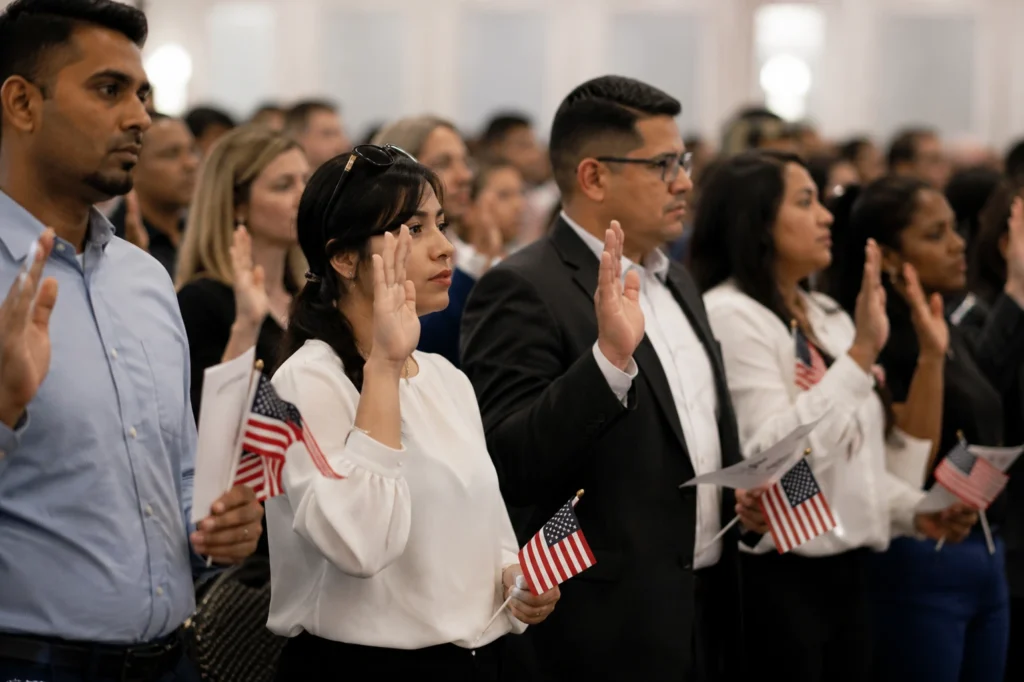
The national debate over Birthright Citizenship has intensified following a sharply worded legal opinion arguing that four members of the U.S. Supreme Court should face impeachment because of their interpretation of the Constitution in a recent case involving President Donald Trump’s executive order on citizenship.
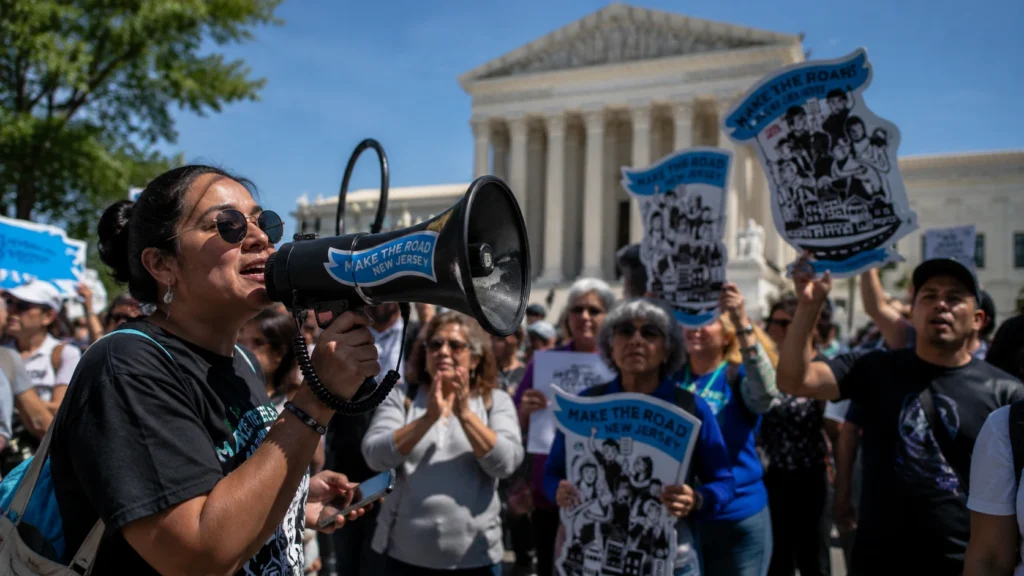
Immigration advocates gather outside the U.S. Supreme Court during a rally supporting birthright citizenship and urging constitutional protections for children born in the United States. AI-generated editorial image.
The commentary, written by a constitutional law professor, criticizes the legal reasoning offered by four justices who supported or expressed agreement with arguments that would allow limits on automatic U.S. citizenship for some children born in the United States. While the article reflects the author’s personal views rather than an official legal proceeding, it has renewed discussion about the scope of the 14th Amendment and the role of the Supreme Court in interpreting constitutional rights.
Birthright Citizenship Remains at the Center of Constitutional Debate
At the heart of the dispute is the Citizenship Clause of the 14th Amendment, which states that all persons born or naturalized in the United States and subject to its jurisdiction are citizens of the United States.
For more than a century, that provision has generally been understood to guarantee citizenship to nearly everyone born on U.S. soil, regardless of their parents’ immigration status, with limited exceptions such as children of foreign diplomats.
The recent controversy emerged after litigation over President Trump’s executive order seeking to narrow the application of birthright citizenship. Opponents argue that the order conflicts with the plain language of the Constitution, while supporters contend that the amendment should be interpreted more narrowly in certain immigration-related circumstances.
Why the Author Calls for Impeachment
The opinion piece argues that four Supreme Court justices departed from the Constitution’s text by supporting an interpretation that considers whether a child’s parents intended to remain permanently in the United States.
According to the author, the Constitution contains no explicit requirement that parents establish permanent residence or legal domicile before a child born in the country can qualify for citizenship.
The professor contends that introducing such a requirement amounts to creating a legal standard not found in the Constitution itself. Based on that reasoning, the commentary concludes that the justices demonstrated a lack of judicial integrity sufficient to justify impeachment.
Those arguments represent the author’s legal opinion and do not reflect any formal impeachment effort currently underway in Congress.
The Justices Named in the Commentary
The opinion specifically identifies four Supreme Court justices:
- Samuel Alito
- Clarence Thomas
- Neil Gorsuch
- Brett Kavanaugh
The author argues that their constitutional interpretation regarding birthright citizenship is inconsistent with both the text of the 14th Amendment and longstanding constitutional principles.
Historical Context Behind Birthright Citizenship
Birthright citizenship was established through the 14th Amendment, adopted in 1868 after the Civil War. The amendment was designed in part to ensure citizenship rights for formerly enslaved people and to provide a clear constitutional definition of national citizenship.
The professor argues that the amendment’s language has historically applied broadly and should not depend on questions about a family’s future plans or immigration intentions.
To illustrate that point, the commentary references generations of immigrants who came to the United States from Europe, Asia, Africa, and Latin America, arguing that many arrived without certainty about permanent residence but nevertheless became part of the nation’s history.
Why the Issue Matters
The debate extends well beyond immigration policy.
Legal experts on both sides have noted that changes to the interpretation of birthright citizenship could affect future citizenship determinations and potentially reshape how constitutional protections are applied.
Supporters of maintaining the traditional interpretation argue that the Citizenship Clause provides a clear constitutional guarantee that should not be narrowed through executive action or judicial reinterpretation.
Those favoring a narrower reading contend that the phrase “subject to the jurisdiction” permits additional constitutional analysis regarding the status of parents at the time of a child’s birth.
The disagreement reflects a broader constitutional debate over how courts should interpret the text of the Constitution, particularly whether judges should rely primarily on the original public meaning of constitutional language or consider evolving legal and policy concerns.
Could Supreme Court Justices Be Impeached?
Although the commentary urges Congress to impeach the four justices, impeachment of Supreme Court members is exceptionally rare.
Under the U.S. Constitution, federal judges, including Supreme Court justices, may be impeached by the House of Representatives and removed only after conviction by a two-thirds vote in the Senate. Historically, successful removals have been extremely uncommon, and disagreements over judicial interpretation alone have generally not resulted in impeachment proceedings.
As of now, there is no active congressional effort to remove the justices named in the opinion.
What Happens Next?
The broader legal battle over Birthright Citizenship is expected to remain a significant constitutional issue as litigation surrounding immigration policies continues.
Future court decisions, congressional actions, or additional executive policies could further shape how the Citizenship Clause is interpreted. For now, the latest commentary adds another voice to an already vigorous national debate over constitutional interpretation, judicial independence, and the limits of executive authority.
While the opinion strongly criticizes several Supreme Court justices and calls for their impeachment, those arguments remain the views of the author rather than findings of a court or actions taken by Congress. The constitutional questions surrounding birthright citizenship are likely to continue generating legal and political discussion in the months ahead.